
TREKKING & ESCURSIONISMO
Verzasca Valley Itinerary: From the fam to Sonogno, Trail of games and nature
The Verzasca Valley begins just north of Lake Maggiore and stretches for about 25 km (16 miles) to Sonogno, the valley's highest and most remote village. Its name comes from the striking green color of the river's water—literally, "green water."
At the entrance to the valley stands the Vogorno Dam, famous as the location of the spectacular bungee jump performed by Pierce Brosnan in the opening scene of GoldenEye. From there, the valley narrows as the Verzasca River carves its way through the rock, creating crystal-clear emerald pools and small waterfalls.
Along the route, you'll pass through a series of charming villages: Corippo, Switzerland's smallest municipality, perched on a rocky hillside; Lavertezzo, home to the iconic 17th-century Ponte dei Salti; Brione Verzasca, Gerra Verzasca, Frasco, and finally Sonogno, the picturesque stone village at the end of the valley.
Verzasca Valley Itinerary with the Wooden Ball Trail
Dam, Ponte dei Salti, the BoBosco Trail, and the emerald-colored pools that people in Milan already call "Switzerland's Maldives."
The valley and its history

Verzasca Valley opens up just north of Lake Maggiore and stretches for about 25 km up to Sonogno, the valley's most remote and highest village. It's shaped like a narrow V, wedged between the mountains that separate it from Leventina Valley and Maggia Valley: peaks rising to an average of 2,400 meters, while the valley floor stays low, between 500 and 900 meters.
The name comes from the color of the water — "green water" — and in this valley, water is everywhere: waterfalls cascading down the mountainsides, and above all the natural pools of the Verzasca River, carved into the rock and famous for their turquoise-emerald color.
Despite its beauty and its closeness to nearby cities — Locarno is just a few kilometers away — for centuries the valley remained hard to reach, and that isolation preserved customs, traditions, and an architecture that would have vanished elsewhere.
At the valley's entrance stands the Vogorno dam, the very one Pierce Brosnan bungee-jumps off in the opening scene of GoldenEye. From there the valley narrows further, the river carves out pools and small waterfalls, and the villages follow one after another: Corippo, Switzerland's smallest municipality, perched on a stone outcrop; Lavertezzo with its 17th-century Ponte dei Salti; Brione Verzasca, Gerra, Frasco, and finally Sonogno.
Getting there and getting around
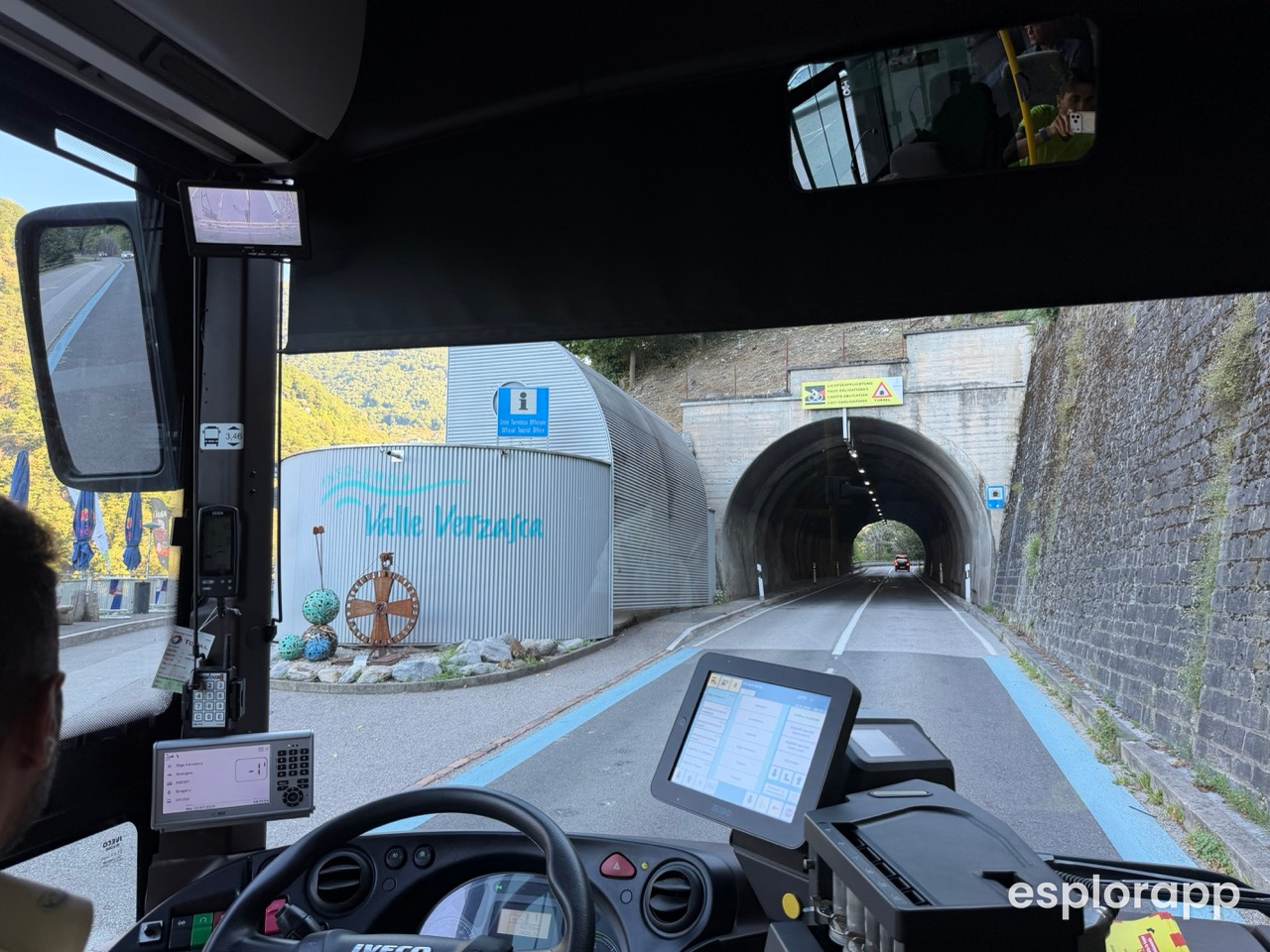
By bus (recommended): from Locarno or Tenero station, the AutoPostale line runs the length of the valley up to Sonogno, stopping at every village.
By car (not recommended): parking along the valley is limited and paid, forcing you to backtrack to your starting point instead of making your way down the valley by bus at your own pace.
Useful stops: Diga Verzasca (for the dam and bungee jumping) · Lavertezzo, Paese (for the Ponte dei Salti) · Brione Verzasca Piee (for the start of the BoBosco Trail) · Sonogno (final stop, for the museum).
The trail: the Sentierone della Valle Verzasca (Verzasca Trail no. 74), a largely flat mule track, easy to break up at any point thanks to the many bus stops along the way.
Ticino Ticket: free buses and discounts for your whole stay

Anyone staying in Ticino — hotel, hostel, or campsite, as long as it's a partner property — gets the Ticino Ticket for free: for the entire length of your stay, it lets you ride every form of public transport in the canton for free, including the AutoPostale line that runs up Verzasca Valley. No need for single tickets, and no need to plan your day around cost — you can hop on and off the bus as many times as you like.
A few things worth knowing before you go:
- It's worth asking your accommodation whether it's part of the program before you book — not every property offers it automatically.
- The ticket also covers discounts on some cable cars and funiculars (including the Locarno–Madonna del Sasso funicular), on lake boat services (the Locarno–Tenero–Magadino route is free), and on several partner attractions.
- It's only valid within Canton Ticino — it can't be used for trips into Italy or other cantons.
It's precisely thanks to the Ticino Ticket that it pays to plan the day around "free-form stops": get off at the dam, take your time at the Ponte dei Salti, catch a later bus on to Brione — every one of those stops becomes free, with no timetable to worry about.
The connection that guides the day
Just like in London and Turkey, what makes the difference during the day is always having data on: real-time bus schedules, the trail map ready offline, and the freedom to decide on the spot whether to stop at Lavertezzo or push on to Sonogno.
With Airalo's eSIM (unlimited data, over 200 destinations) the code DANIELECC10 gets you a discount on activation.
As always, we'll say goodbye here and see you at the next Esplorazione 🌿
EsplorApp · esplorapp.it · @daniele.cc
Stage 1 — Vogorno Dam and Corippo
You'll see the dam a few stops before the Ponte dei Salti, getting off at the "Diga Verzasca" stop — or on foot on the way back, if you'd rather end the day there instead of at Lavertezzo. It's not a point you pass through while walking the rest of the Sentierone: it's a separate stop, to plan for on its own within your bus itinerary.
You start at the Contra dam, the imposing 220-meter wall built across the Verzasca River — the same one James Bond leaps from in the opening scene of GoldenEye. Beneath the surface of the artificial lake it created, the remains of the old road and of a hamlet, Pioda, still rest, submerged when the reservoir was filled.
The trail follows the old mule track and passes through a few of Vogorno's small hamlets before climbing toward Corippo. With just over 50 residents, it's one of Switzerland's smallest municipalities by population: single-room stone houses, all facing the same direction, roofed with piode, the gneiss slabs found all over the valley. The village is first mentioned in a document dating to 1224, and in 1975 the Swiss Confederation and Canton Ticino chose it as a historic settlement to preserve — which is how the Corippo Foundation came about, still working today to keep it preserved and alive (there's even a "scattered hotel" project spread across the village's houses).
From here the valley view opens up — one of the most striking stretches of the entire Sentierone.
Stage 2 — Lavertezzo and the Ponte dei Salti
You descend toward Lavertezzo, home to the valley's most photographed sight: the Ponte dei Salti, a two-arch stone bridge from the 17th century spanning pools and rocks smoothed by the emerald-green water. This is where you swim: the flat rocks make a natural beach.
Taking the 8:15 bus from Tenero gets you to the bridge around 8:45 — an hour when the place is still nearly empty. It's worth taking your time there: we stayed about two hours, taking photos with no one else around, with the river's sound as the only backdrop. With the Ticino Ticket the buses are free, so after the stop you can simply catch the next bus on to Brione Verzasca, where the BoBosco Trail begins, with no single ticket to worry about.
Stage 3 — The BoBosco Trail, first section
From Brione Verzasca, the first half of the BoBosco Trail ("Ball in the Woods") begins: about 5.5 km to Lavertezzo, built entirely from local chestnut wood. You buy a wooden ball at one of the sales points along the valley (roughly CHF 7-9, worth double-checking — available from mid-March to mid-November) and send it running through around a dozen stations: tunnels, channels that follow the river's current, balance passages.
- The first kilometer, closest to the river, is the narrowest and most exciting stretch.
- With young children, it's better to start from the Ganne stop, where the trail is easier.
The fork: how to continue the day
Option A — Push on to Sonogno. Continue along the Sentierone through Gerra and Frasco, stopping at grotti along the way, all the way to the valley's most remote village. Sonogno has the Museo di Val Verzasca, housed in a typical Verzasca-style home. It adds several extra hours of walking: only worth it if you set off early in the morning.
Option B — Stop at Lavertezzo. Swim in the pools by the Ponte dei Salti, take your time at Corippo, and catch the bus back in the afternoon. The right call with young children, or if you got a late start.
Family variant — second section of the BoBosco. Take the bus to Gerra Verzasca for the second half of the BoBosco Trail, the one that runs to Sonogno: shorter, with simpler stations, designed for younger children.
Stage 4 — Sunset via the historic funicular to the Madonna del Sasso Sanctuary
From Locarno, the historic funicular climbs to Orselina in just a few minutes: a single track following the course of the Ramogna stream, still running the same vintage 1958 carriages. With the Ticino Ticket, the fare is discounted.
The intermediate stop — Santuario Madonna del Sasso, on request — is the one worth getting off at: from there, the Sacro Monte, the sanctuary set into the rock above Locarno, is just steps away. From here it's worth making your way back down on foot, along the Via Crucis: the old cobbled path that once connected Locarno to the sanctuary before the funicular was built, dotted with chapels depicting the Passion along the way down.
It's along this stretch that you get the most striking moment: partway along its route, the funicular has a section with double track, where the two carriages cross — one going up, one going down, at the very same instant. Watching from outside, walking the Via Crucis, it feels like stepping back a century in time.
The best time to do this is toward evening: ride the funicular up, visit the sanctuary as the light changes, and walk back down with the sunset over Lake Maggiore behind you.
Technical info
- Start: Vogorno Dam · End: Sonogno (or Lavertezzo, for the shorter version)
- Villages along the way: Corippo · Lavertezzo · Brione Verzasca · Gerra · Frasco · Sonogno
- Trail: Sentierone della Valle Verzasca (Verzasca Trail no. 74)
- BoBosco Trail: 2 sections, 9.8 km total (Brione–Lavertezzo and Gerra–Sonogno)
- Distance Lavertezzo–Sonogno: roughly 13-15 km
- Time: about 3.5-4 hours to Lavertezzo · a full day to reach Sonogno
- Difficulty: easy, suitable for families too
- Best time to go: mid-March to mid-November
What to bring
Comfortable shoes or light hiking boots, closed-toe if possible — the trail alternates rocks, roots, and wet stretches near the river. A swimsuit and towel under your clothes: the swimming happens sooner than you'd expect. Small-denomination cash (CHF) for the wooden ball and for the grotti, which often don't take cards. Enough water: the Brione–Lavertezzo stretch has fewer fountains than the rest of the valley, though there are several refreshment points along the trail.
Practical tips
- Departure time: to reach Sonogno and get back the same day, it's best to catch one of the first morning buses from Locarno or Tenero.
- Swimming: the current is stronger than it looks and the water stays cold year-round; the pools near the Ponte dei Salti are the safest and most popular.
- With children: the first kilometer of the BoBosco from Brione is the narrowest and closest to the river — better to start from the Ganne stop.
- Phone signal: good in the lower part of the valley, patchier heading up toward Sonogno — worth downloading the map offline before setting off.
- Peak season: in summer months the bus line gets very busy — set off early, both for a quieter trail and to find a seat.
Best spots for photos
The Ponte dei Salti at Lavertezzo, early in the morning, before the weekend crowds arrive. The BoBosco installations along the river, with the wooden ball in the foreground and the chestnut forest behind. The village of Corippo from below, its stone houses climbing up the outcrop. Sonogno at the end of the day, in the late afternoon, once the day's buses have already left.
The 6 stops along the route
Reviews
No reviews